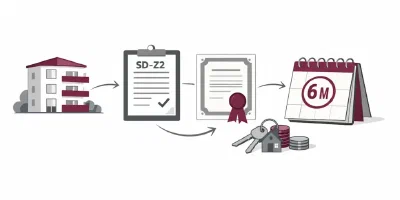
Three years after the rules on the family foundation entered into force, the Ministry of Development and Technology — with the participation of the Ministry of Finance — published, on 12 June 2026, a comprehensive review of how this institution operates. Public consultations were launched alongside the publication of the document. The package of 25 proposed changes has caused a stir among entrepreneurs. The government announces a crackdown on the use of foundations for aggressive tax optimisation and plans a complete reorganisation of the tax model.
Succession or aggressive optimisation? Why the tax authority wants change
The main conclusion of the government’s report is that current market practice has drifted away from the original purpose of the Act. The family foundation was meant to be a tool facilitating the intergenerational succession of Polish businesses. The data for 2023–2025, however, show it has become a popular vehicle for the ongoing management of tax efficiency.
The scale of the phenomenon is illustrated by the figures:
- foundations reported a combined total of more than PLN 33 billion of income exempt from CIT — chiefly from holdings in companies and investment funds and from trading in securities;
- over the same period, PLN 251 million in total flowed to the state budget by way of CIT;
- in as many as 44% of cases the group of founders overlaps with the group of beneficiaries (often the founder is the sole beneficiary and retains full operational control).
The review’s authors note that comparing these amounts is a calculation of opportunity cost (assuming the income would otherwise be earned outside a foundation by ordinary taxpayers), not a direct measure of budget loss. The tax authority nonetheless warns that income is accumulated in the foundation indefinitely and is not subject to current taxation.
A tax revolution: deferred CIT replaced by PIT?
The Ministry of Finance proposes moving away from the current entity-level exemption of foundations from CIT towards item-based exemptions, and introducing differentiated tax rates. The key concepts include:
- A new model for taxing benefits. The most far-reaching proposal shifts the tax burden from the foundation onto the beneficiaries. Instead of CIT paid by the foundation on distribution, benefits would be subject to personal income tax (PIT) on the beneficiaries, with the rate depending on the value of distributions in a given year (abandoning the division by degree of kinship).
- A tax on assets contributed. Consideration is being given to taxing “working” assets (e.g. shares, real estate) contributed to a foundation, in order to reduce the appeal of quick speculative transactions. Typically succession-related assets (e.g. works of art, precious metals) would be exempt.
- Taxation of commercial activity. The tax authority wants to monitor and tax the foundation’s operating activity more closely (e.g. large-scale leasing, financing related entities through loans).
- An opt-in principle for existing foundations. Crucially for current founders, the new, deeply reformed tax model would be mandatory for newly established foundations and optional for entities that already exist.
As regards urgent anti-avoidance measures (a so-called minor correction), the government wants to revive the provisions vetoed by the President of Poland from the Act of 17 October 2025, which introduced, among other things, a 3-year lock-up on donated assets, the application of the CFC (controlled foreign company) regime to foundations, and the taxation of short-term rental.
Digitalisation and moving foundations into the KRS
Alongside the tax changes, the review brings long-awaited, positive organisational and civil-law proposals. The answer to founders’ biggest grievance — the months-long wait for registration at Poland’s single competent court in Piotrków Trybunalski — is to be the full digitalisation of procedures and the incorporation of the family-foundation register into the National Court Register (KRS).
Additional plans include:
- clarifying the rules on representing a foundation while it is in the course of formation;
- stating clearly in law that benefits from a foundation form the beneficiary’s separate property (and do not enter the marital community of property);
- liberalising the rules on contributing and transferring agricultural real estate to close beneficiaries;
- allowing the creation of additional, optional bodies within the foundation’s structure.
What does this mean for businesses?
For now the document is a policy-direction draft setting the axis of the coming legislative debate. Entrepreneurs who are planning to set up a family foundation, or who already use one, should follow the legislative process closely. While the organisational improvements (the KRS, digitalisation) will be welcomed, the planned tightening and rebuilding of the tax system could fundamentally change the viability and structure of this solution in Poland.
If you are considering a family foundation as a tool for succession of assets or a business, it is worth analysing now whether it is more advantageous to establish one under the current rules or to wait for the final shape of the reform. Our tax advisers and lawyers help plan succession with both scenarios in mind.
Frequently asked questions
Will family foundations lose their CIT exemption? According to the draft, yes — the government plans to move away from the entity-level CIT exemption towards item-based exemptions. The most far-reaching proposal shifts taxation of foundation benefits onto beneficiaries under personal income tax (PIT).
Will the changes affect existing foundations? The new tax model is to be mandatory for newly established foundations and optional for existing ones. Some anti-avoidance measures (e.g. the lock-up, the CFC regime) may, however, reach a wider range of entities.
Is it still worth setting up a family foundation? For succession purposes the foundation remains an attractive tool, but its viability depends on the final shape of the tax reform. The decision should be preceded by an analysis of both scenarios — setting up under the current rules or after the changes.
When will the changes take effect? This is still a policy-direction draft submitted for public consultation (12 June 2026). The final shape and date of entry into force depend on the course of the legislative process.
 Olga Wierzbicka
Recommended Articles


Have questions?
Contact us to discuss your case.
Get in touch