Company Formation in Poland — Law Firm for Foreign Founders
Form a Polish sp. z o.o. as a foreigner — no Polish partner, incorporation by power of attorney. English-speaking attorneys handle KRS, tax and CRBR filings.
Last updated:
Forming a company in Poland is fully open to foreign founders: you don't need a Polish partner or Polish residence, and a single foreigner can own 100% of a Polish limited liability company (sp. z o.o.). As a law firm, we most often incorporate for non-residents by notarial deed under a power of attorney — with no travel to Poland — in 2–4 weeks, with articles of association tailored to your ownership structure; founders who hold a Polish trusted profile can instead use the online S24 system (1–5 business days). We run the whole process in English — choice of legal form, drafting the articles, registration in the National Court Register (KRS), and the tax, social-security and beneficial-owner filings — and stay on as your legal team afterwards, from shareholder agreements to investor entry. One practical note: while incorporation itself is fully remote, opening a Polish bank account usually requires one short in-person visit, which we coordinate.
Key facts
- Most common form
- Limited liability company (sp. z o.o.)
- Minimum share capital
- PLN 5,000 (approx. €1,200)
- Foreign ownership
- 100% permitted — no Polish partner or resident director required
- Set up remotely
- Incorporation: yes, by power of attorney — bank account opening usually needs one short visit
- Timeline
- 2–4 weeks (notarial deed by PoA) or 1–5 business days (S24 online, Polish trusted profile required)
- Official court fees
- PLN 250 + PLN 100 (S24) or PLN 500 (traditional)
When do you need this service?
- You are a foreign company opening a subsidiary or branch in Poland
- You are an investor or entrepreneur from abroad setting up in Poland for the first time
- Your ownership structure is non-standard — holding companies, several jurisdictions, or custom articles a template can't handle
- You aren't sure which form fits — sp. z o.o., P.S.A., S.A. or a sole proprietorship
- You are going into business with a partner and want the ground rules set clearly
- You are bringing in an investor or selling shares in your company
- You want to limit your personal liability for the business's obligations
How the process works
- 1Analysis and choice of legal formWe discuss your business model, growth plans and tax situation, then recommend the optimal form of activity.
- 2Preparing the documentsWe draft the articles of association or statute, the list of shareholders and the full set of registration documents tailored to the chosen form.
- 3Signing the articles of associationThe deed is concluded electronically via the S24 system or as a notarial deed (including by power of attorney for non-residents), depending on the company type and the contributions made.
- 4Registration with the KRSWe file the application for entry in the National Court Register together with the required attachments and fees.
- 5Filings with the tax office, ZUS, GUS and CRBRWe complete the identification filings (NIP, VAT-R), register the company as a contributions payer and report the beneficial owners to the CRBR.
- 6A company ready to operateWe hand over the complete documentation and, if needed, take the company on for ongoing legal, accounting and tax support.
What you'll need
- Details of the shareholders (or of the parent company for a subsidiary)
- The proposed company name and registered-office address
- The scope of business activity (PKD codes)
- The amount of share capital and the split of shares
- Details of the management board and the manner of representation
- Passport or identity document (PESEL number is not required to start)
What we cover
- Choosing the optimal legal structure (sole trader, sp. z o.o., S.A., partnerships)
- Drafting, amending and adapting articles of association and statutes
- KRS registration and notifications to tax office (NIP/VAT), ZUS and GUS
- KRS updates — changes to management board, shareholders and registered data
- Ongoing corporate legal services (management board, supervisory board, shareholder meetings)
- Shareholder and general meetings management (minutes, resolutions, notices)
- Shareholders' agreements, investment agreements and exit arrangements
- Investor entry — due diligence, negotiations and transaction documentation
- Sale and acquisition of shares
- Company conversions, mergers and demergers
- Company winding-up and deregistration from KRS
- Corporate disputes — challenging resolutions, shareholder conflicts
- Directors' liability advisory
- Registration of foreign company branches and representative offices in Poland
For foreign founders and investors
Poland is one of the most popular destinations in the EU for foreign investment, and we regularly set up companies for clients from Germany, Austria, the UK, the US and Ukraine. EU and EEA citizens may establish a business on exactly the same terms as Polish nationals; investors from outside the EU most often use a sp. z o.o., which is open to founders of any nationality — with no requirement for a Polish partner or a Polish-resident director.
Foreign founders should plan for a few practical points: signing in the S24 system requires a Polish electronic signature or trusted profile (ePUAP), which usually presupposes a PESEL number, so non-residents often incorporate by notarial deed instead — and this can be done by power of attorney, without travelling to Poland. After registration, a company has the same obligations as any Polish entity, including beneficial-owner reporting to the CRBR and, where relevant, VAT registration.
Foreign clients work with one team for the whole setup and everything that follows. Our managing partner is admitted to the New York State Bar and serves as the New York State Bar Association's Chapter Chair for Poland, and the firm is trusted counsel (Vertrauensanwalt) to the Austrian Consulate General in Kraków. We advise in English, German, Ukrainian and Russian, and coordinate notaries and sworn translators. Bookkeeping, payroll, VAT compliance and bank-account setup are handled by our sister company Sarego Finance, based in the same building and headed by the firm's partner and tax advisor Jerzy Gaweł — so legal, tax and banking are handled as one process. The incorporation itself is handled by the law firm. We also take care of the related matters foreign clients usually need, such as residence and work permits and double-taxation questions.
What can delay the formation
- The bank account and KYC check. Most Polish banks ask at least one managing director to attend a short in-person appointment for the identity and KYC check before they open the account. We put that appointment into the timetable from the start instead of looking for a date after registration.
- The power of attorney is in the wrong form. The articles of association of a sp. z o.o. must be a notarial deed (art. 157 § 2 of the Commercial Companies Code), and a power of attorney for an act that requires a form must be granted in the same form (art. 99 § 1 of the Civil Code). A simple signed power of attorney is therefore not enough for a notarial formation.
- The apostille or sworn translation is missing. Powers of attorney signed abroad and the parent company's documents need, depending on the issuing country, an apostille and a sworn translation into Polish. If either is missing, the notary appointment moves.
- S24 without a PESEL number. Online formation through S24 needs a Polish electronic signature or trusted profile, which usually requires a PESEL number. Without one, the route is the notarial deed.
- Not every managing director can be reached. The application for entry in the KRS is signed by all members of the management board (art. 164 § 1 of the Commercial Companies Code). A representative can file it only if all board members have jointly authorised them.
- The CRBR deadline after registration. The beneficial owners must be reported to the Central Register of Beneficial Owners (CRBR) within 14 working days of entry in the KRS (art. 60(1)(1) of the Polish Anti-Money Laundering Act), electronically and by a person authorised to represent the company.
Practical notes for foreign managing directors
- You do not need to live in Poland: a single foreign founder can be the sole shareholder and the sole managing director of a sp. z o.o.
- You do not need a PESEL number to start. In the CRBR report, the date of birth is given instead of a PESEL (art. 61(1a)(4) of the Anti-Money Laundering Act).
- Plan one trip to Poland, but for the bank, not for the formation: registration runs on a power of attorney.
- As managing director you are personally liable for the company's debts if the insolvency petition is not filed in time or enforcement against the company fails (art. 299 of the Commercial Companies Code).
- After registration the ongoing duties start: full accounting, annual accounts filed with the KRS, corporate income tax, JPK_VAT where applicable, and up-to-date KRS and CRBR data.
Who advises you
The lawyers at the firm who advise on this area. Each links to a full profile.

Attorney-at-Law / Managing Partner
Polish and U.S. (New York State) Attorney-at-Law. Founder and managing partner. Specialises in international commercial law, cross-border disputes, and mergers & acquisitions. Attorney of Trust (Vertrauensanwalt) for the Austrian Consulate General in Kraków.
- Speaks: Polish, English, German
- International Commercial Law
- Litigation and Arbitration
- Company Law and Commercial Law
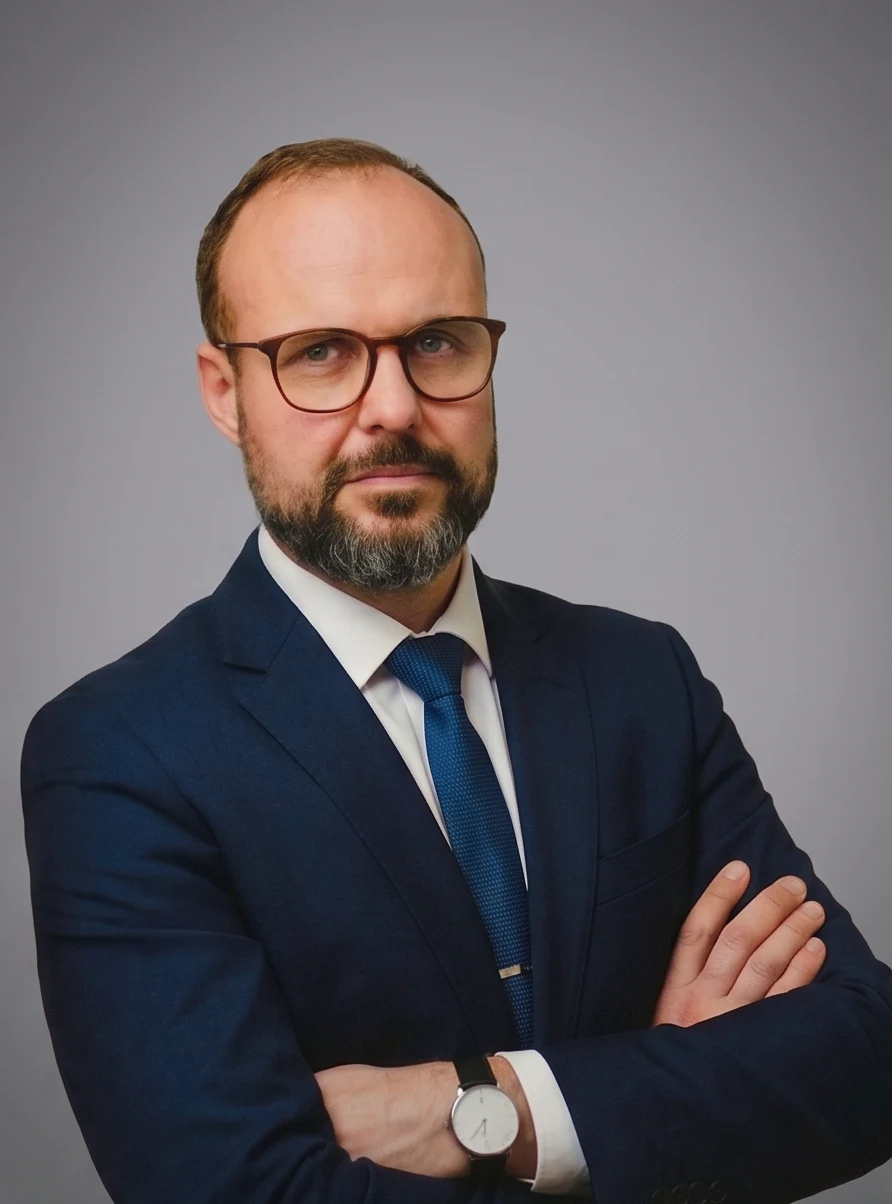
Senior Partner / Tax Advisor
Senior Partner, Tax Advisor and CEO of Sarego Finance. Advises Polish and foreign companies on international transactions, corporate structures and cross-border tax issues across Poland, Germany, Austria, Switzerland and the USA. Combines 25 years of legal and tax experience with multilingual practice in Polish, English and German.
- Speaks: Polish, English, German
- Tax Law
- International Contract Law
- Corporate Structures
Frequently Asked Questions
Should I register a limited liability company (sp. z o.o.) or a sole trader?
How long does it take to register a company in Poland?
What is the minimum share capital for a Polish sp. z o.o.?
Can a foreign national register a company in Poland?
Do you also assist with company conversions and mergers?
What is a shareholders' agreement and when should one be concluded?
When can a company director be personally liable for the company's debts?
How much does it cost to set up a sp. z o.o.?
Can I set up a company in Poland remotely, without travelling?
What obligations does a company have after registration?
Do I need a Polish partner or a Polish-resident director to open a company?
Ready to discuss your case?
Our lawyers are available to advise you in Polish, English, German, Ukrainian and Russian.
Discuss your case